
SteelonCall Journal
Binding Wire Suppliers in Coimbatore: A Complete Guide for Construction Projects
Steeloncall
27 September 2026 · 13 min read
On this page
- What Is Binding Wire?
- Why Is Binding Wire Important in Construction?
- Where Is Binding Wire Used?
- Binding Wire and TMT Bars
- Types of Binding Wire
- What Is Black Annealed Binding Wire?
- What Is Galvanized Binding Wire?
- Common Binding Wire Sizes
- How to Choose Binding Wire for Construction
- How Much Binding Wire Is Required for a Construction Project?
- Binding Wire Consumption With TMT Bars
- Binding Wire for Residential Construction
- Binding Wire for Commercial Buildings
- Binding Wire for Industrial Construction
- How to Choose Binding Wire Suppliers in Coimbatore
- Why Supplier Reliability Matters
- How to Compare Binding Wire Supplier Quotations
- What Affects Binding Wire Prices?
- Should You Buy Binding Wire in Bulk?
- Buying Binding Wire Online in Coimbatore
- Benefits of Online Procurement for Binding Wire
- Binding Wire Storage at Construction Sites
- Binding Wire Quality Checks
- Binding Wire vs Welding
- Common Mistakes When Buying Binding Wire
- Binding Wire Procurement Checklist
- Binding Wire and Other Construction Materials
- Binding Wire for TMT Reinforcement
- How Contractors Can Plan Binding Wire Procurement
- Buying Binding Wire Along With TMT Bars
- Why Choose SteelOnCall for Steel Procurement in Coimbatore?
- How to Request a Binding Wire Quotation
- When Should You Order Binding Wire?
- Final Guide to Binding Wire Suppliers in Coimbatore
- Frequently Asked Questions
Binding wire is a small but essential construction material used extensively in reinforced concrete construction. It is primarily used to tie TMT bars together before concrete is poured, helping maintain the required reinforcement arrangement during construction.
If you are searching for Binding Wire Suppliers in Coimbatore, choosing the right product and supplier can make material procurement easier and help avoid unnecessary delays at the construction site.
Binding wire is commonly required for:
-
Residential buildings
-
Commercial buildings
-
Apartments
-
Industrial structures
-
Foundations
-
Columns
-
Beams
-
Slabs
-
Infrastructure projects
Although binding wire is relatively inexpensive compared with major steel products, its availability is important because reinforcement work depends on it.
If you are also sourcing reinforcement steel, explore TMT Bar Dealers in Coimbatore.
This guide explains what binding wire is, where it is used, how much you may need, what to check when buying it and how to choose reliable binding wire suppliers in Coimbatore.
What Is Binding Wire?
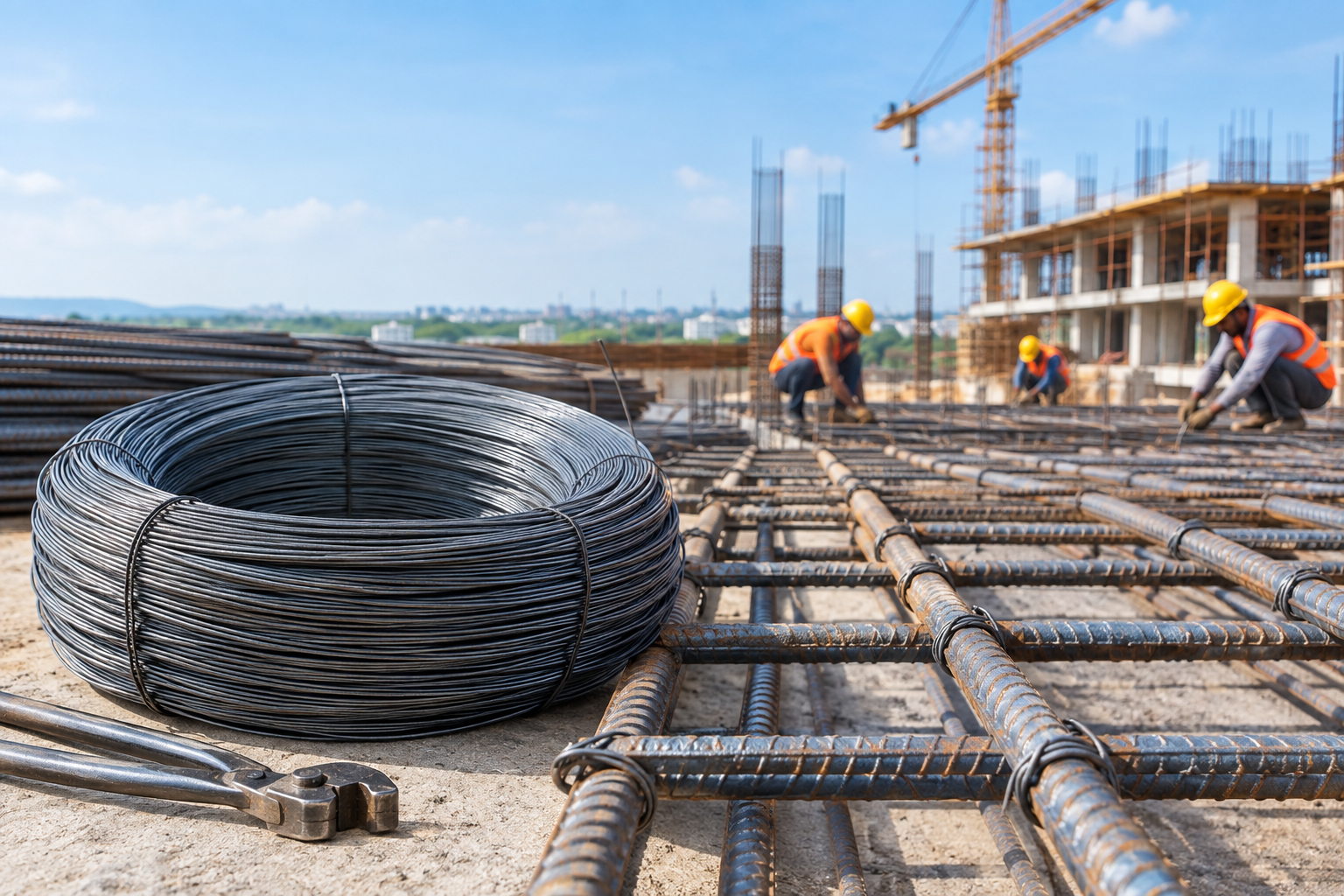
Binding wire is a flexible steel wire commonly used to tie reinforcement bars together.
During reinforced concrete construction, TMT bars are arranged according to structural drawings. Binding wire is then used to secure the intersections of the reinforcement bars.
The main purpose is to keep the reinforcement arrangement stable during:
-
Reinforcement placement
-
Shuttering activities
-
Concrete pouring
-
Construction-site movement
Binding wire is not used as a replacement for structural reinforcement. Its primary purpose is to tie and hold reinforcement bars in their required positions.
Why Is Binding Wire Important in Construction?
TMT bars need to remain in their specified positions before and during concrete placement.
Binding wire helps workers secure the reinforcement cage or grid.
It is commonly used for:
-
Slab reinforcement
-
Beam reinforcement
-
Column reinforcement
-
Footing reinforcement
-
Foundation reinforcement
-
Wall reinforcement
Without suitable tying material, maintaining the reinforcement arrangement can become more difficult.
For this reason, contractors usually include binding wire in their construction material procurement plan.
Where Is Binding Wire Used?
Binding wire is used in several stages of reinforced concrete construction.
1. Foundations
Binding wire is used to tie reinforcement bars in footing and foundation reinforcement.
2. Columns
Vertical and horizontal reinforcement components can be tied together using binding wire.
3. Beams
Binding wire is commonly used to secure longitudinal reinforcement and stirrups.
4. Slabs
Reinforcement grids are tied at intersections before concrete placement.
5. Walls
Depending on the structural design, binding wire can be used to secure reinforcement in reinforced concrete walls.
Binding Wire and TMT Bars
Binding wire and TMT bars perform completely different functions.
|
Product |
Main Purpose |
|
TMT Bars |
Reinforcement in concrete |
|
Binding Wire |
Tying reinforcement bars |
|
Cement |
Binder in concrete and mortar |
|
Aggregates |
Concrete constituent |
|
Shuttering |
Temporary formwork |
If you are purchasing TMT bars along with binding wire, you can explore Buy TMT Bars Online in Coimbatore.
Types of Binding Wire
Binding wire can differ based on its thickness, finish and intended use.
Commonly encountered categories include:
-
Black annealed binding wire
-
Galvanized binding wire
-
Mild steel binding wire
-
Construction binding wire
The appropriate product depends on the project requirements and site conditions.
For ordinary reinforcement tying, construction projects commonly use flexible steel binding wire that can be easily twisted manually or using suitable tying tools.

What Is Black Annealed Binding Wire?
Black annealed wire is a commonly used type of binding wire.
The annealing process makes the wire relatively soft and flexible, making it easier for construction workers to twist and tie around reinforcement bars.
It is commonly used for:
-
TMT bar tying
-
Slab reinforcement
-
Beam reinforcement
-
Column reinforcement
-
Foundation reinforcement
The exact wire specification should be selected according to project requirements.
What Is Galvanized Binding Wire?
Galvanized wire has a zinc coating that provides additional corrosion protection.
It may be considered for applications where improved resistance to environmental exposure is required.
However, for ordinary RCC reinforcement tying, the project specification and site requirements should determine whether galvanized wire is appropriate.
Common Binding Wire Sizes
Binding wire is available in different gauges and diameters.
The required size depends on:
-
TMT bar diameter
-
Reinforcement arrangement
-
Construction practice
-
Tying method
-
Project requirements
The wire should be flexible enough to tie securely without unnecessary difficulty.
Instead of selecting a wire solely by gauge, buyers should confirm the exact diameter or specification offered by the supplier.
How to Choose Binding Wire for Construction
Choosing binding wire may appear simple, but several factors should be considered.
Flexibility
The wire should be easy to twist around reinforcement bars.
Strength
It should hold the reinforcement securely during construction activities.
Surface Condition
The wire should have a suitable finish without excessive defects.
Consistent Diameter
Uniform wire dimensions help maintain consistent tying performance.
Quantity
Estimate the required quantity based on reinforcement work and project size.
How Much Binding Wire Is Required for a Construction Project?
The quantity of binding wire required depends on the reinforcement quantity and tying pattern.
There is no single quantity that applies to every construction project.
It can vary depending on:
-
Total TMT steel quantity
-
Bar diameter
-
Reinforcement spacing
-
Number of intersections
-
Structural design
-
Construction practices
-
Method of tying
For an accurate estimate, contractors can use previous project consumption data or the project's material planning method.
The final requirement should be adjusted based on actual site consumption.
Binding Wire Consumption With TMT Bars
Since binding wire is primarily used with reinforcement steel, its consumption generally increases as the quantity of reinforcement work increases.
A project with a large amount of TMT reinforcement may require significantly more binding wire than a small residential project.
For procurement planning, consider:
TMT Quantity + Reinforcement Layout + Tying Method + Expected Wastage = Binding Wire Requirement
Avoid placing an order based only on the built-up area of the building.
Binding Wire for Residential Construction
Residential projects require binding wire during reinforcement work for:
-
Footings
-
Columns
-
Beams
-
Slabs
-
Staircases
-
Other RCC elements
For smaller projects, contractors often purchase binding wire along with TMT bars and other construction materials.
For general steel requirements, explore Steel Suppliers in Coimbatore.
Binding Wire for Commercial Buildings
Commercial buildings can involve larger reinforcement quantities and therefore higher binding wire consumption.
Projects such as:
-
Office buildings
-
Shopping complexes
-
Hotels
-
Apartment buildings
-
Institutional buildings
may require planned procurement of binding wire along with reinforcement steel.
For larger construction requirements, explore Construction Steel Suppliers in Coimbatore.
Binding Wire for Industrial Construction
Industrial projects can require substantial reinforcement and concrete work.
Binding wire may be required for:
-
Foundations
-
Equipment bases
-
RCC structures
-
Platforms
-
Structural components
Industrial buyers should coordinate binding wire procurement with the reinforcement schedule.
If the project also requires structural sections, explore Structural Steel Suppliers in Coimbatore.
How to Choose Binding Wire Suppliers in Coimbatore
When searching for Binding Wire Suppliers in Coimbatore, compare suppliers based on more than just price.
Product Quality
The wire should be suitable for the intended construction application.
Flexibility
Workers should be able to twist the wire without excessive effort.
Availability
The supplier should be able to provide the required quantity when needed.
Packaging
Check whether the wire is supplied in suitable coils or bundles.
Bulk Supply
Large projects may require repeated or bulk deliveries.
Delivery
The supplier should be able to deliver to the required project location.
Pricing
Compare the final cost rather than only the quoted basic rate.
Why Supplier Reliability Matters
A shortage of binding wire can interrupt reinforcement work even though it is a relatively small construction item.
For example, if a contractor has sufficient TMT bars but runs out of binding wire, reinforcement tying may have to stop.
A reliable procurement process helps reduce such interruptions.
This is particularly important for:
-
Large projects
-
Multi-storey buildings
-
Apartment projects
-
Industrial projects
-
Projects with tight schedules
How to Compare Binding Wire Supplier Quotations
When comparing quotations, check whether all suppliers are quoting the same product specification.
|
Factor |
Supplier A |
Supplier B |
Supplier C |
|
Wire Type |
Check |
Check |
Check |
|
Diameter/Gauge |
Check |
Check |
Check |
|
Quantity |
Check |
Check |
Check |
|
Packaging |
Check |
Check |
Check |
|
Basic Price |
Check |
Check |
Check |
|
Freight |
Check |
Check |
Check |
|
Taxes |
Check |
Check |
Check |
|
Delivery |
Check |
Check |
Check |
|
Final Cost |
Compare |
Compare |
Compare |
This helps prevent comparisons between different specifications.
What Affects Binding Wire Prices?
Binding wire prices can vary based on:
-
Wire diameter
-
Material
-
Manufacturing process
-
Quantity
-
Packaging
-
Manufacturer
-
Market conditions
-
Freight
-
Applicable taxes
Bulk orders may have different commercial terms from small purchases.
Therefore, buyers should request a current quotation before placing an order.
Should You Buy Binding Wire in Bulk?
Bulk procurement can make sense for larger construction projects.
However, the decision depends on:
-
Project duration
-
Storage space
-
Consumption rate
-
Delivery availability
-
Price
-
Site requirements
For a large project, planned deliveries may be preferable to storing the entire requirement at the site.
Buying Binding Wire Online in Coimbatore
Online steel procurement can simplify the initial enquiry process.
Instead of contacting multiple dealers individually, buyers can submit their requirements online.
A useful enquiry should include:
Product: Binding Wire
Type: Black Annealed/As Required
Diameter: Required specification
Quantity: Required quantity
Application: RCC Construction
Delivery Location: Coimbatore
For customers looking for digital steel procurement, explore Online Steel Purchase in Coimbatore.
Benefits of Online Procurement for Binding Wire
Convenient Enquiry
Submit your requirement without travelling to multiple suppliers.
Easy Requirement Sharing
Share product specifications and quantity digitally.
Bulk Procurement
Submit large construction requirements.
Delivery Coordination
Discuss delivery requirements with the supplier.
One Procurement Channel
If you are buying TMT bars and other steel products, you may be able to coordinate multiple requirements through the same procurement channel.
Binding Wire Storage at Construction Sites
Binding wire should be stored properly to reduce unnecessary damage and handling issues.
Good practices include:
-
Store coils in an organised location.
-
Keep material away from unnecessary moisture.
-
Separate different wire specifications.
-
Maintain stock records.
-
Avoid excessive handling.
-
Follow appropriate site storage practices.
For large projects, designate a specific area for construction consumables.
Binding Wire Quality Checks
Before accepting a shipment, buyers can check:
-
Wire diameter
-
Surface condition
-
Flexibility
-
Packaging
-
Quantity
-
Product identification
For project-specific requirements, follow the quality control procedures established by the contractor or project consultant.
Binding Wire vs Welding
Binding wire is commonly used to tie reinforcement bars, while welding creates a permanent welded connection.
These are different construction methods.
Whether reinforcement should be tied, welded or connected using another method depends on the structural design and applicable construction specifications.
Binding wire is generally used because it is convenient for securing reinforcement before concrete placement.
Common Mistakes When Buying Binding Wire
1. Buying Only Based on Price
A cheaper product may not provide the required flexibility or specification.
2. Not Checking Gauge or Diameter
Different wire sizes have different characteristics.
3. Underestimating Quantity
Running out during reinforcement work can delay construction.
4. Ignoring Packaging
Poorly organised coils can make handling difficult.
5. Not Planning Delivery
Ensure the wire arrives before reinforcement work begins.
6. Buying Without Checking TMT Requirements
Binding wire consumption is closely related to reinforcement work.
Binding Wire Procurement Checklist
Before ordering, check:
|
Requirement |
Check |
|
Wire type |
✓ |
|
Diameter/gauge |
✓ |
|
Quantity |
✓ |
|
Packaging |
✓ |
|
Manufacturer |
✓ |
|
Application |
✓ |
|
Price |
✓ |
|
Freight |
✓ |
|
Taxes |
✓ |
|
Delivery location |
✓ |
|
Delivery date |
✓ |
|
Storage space |
✓ |
Binding Wire and Other Construction Materials
A typical RCC construction project may require:
-
TMT bars
-
Binding wire
-
Cement
-
Aggregates
-
Sand
-
Shuttering materials
-
Construction chemicals
From the steel procurement side, buyers may also require:
-
Steel plates
-
Steel beams
-
Steel pipes
-
Structural sections
For steel plate requirements, explore Steel Plates Suppliers in Coimbatore.
For beam requirements, explore Construction Steel Beams Suppliers in Coimbatore.
Binding Wire for TMT Reinforcement
Binding wire is particularly important during TMT reinforcement work.
A typical reinforcement sequence is:
Structural Drawing → TMT Cutting & Bending → Reinforcement Placement → Binding → Inspection → Concrete Pouring
The binding process helps hold the reinforcement arrangement in place before and during concrete placement.
For TMT procurement requirements, explore TMT Bar Dealers in Coimbatore.
How Contractors Can Plan Binding Wire Procurement
Contractors can simplify procurement by preparing a material requirement before starting reinforcement work.
The requirement can include:
-
Estimated TMT quantity
-
Reinforcement schedule
-
Binding wire specification
-
Required quantity
-
Delivery date
-
Project location
-
Storage arrangement
This helps reduce last-minute purchases.
Buying Binding Wire Along With TMT Bars
For many construction projects, it can be convenient to procure binding wire along with reinforcement steel.
Instead of managing separate enquiries, contractors can include:
TMT Bars + Binding Wire
in their procurement planning.
This can make material coordination easier and reduce the chance of missing an essential construction consumable.
Why Choose SteelOnCall for Steel Procurement in Coimbatore?
If you are looking for Binding Wire Suppliers in Coimbatore, SteelOnCall provides an online route for submitting steel and construction-related steel product requirements.
Customers can share details such as:
-
Product
-
Specification
-
Quantity
-
Brand preference
-
Delivery location
This can be useful for:
-
Builders
-
Contractors
-
Homeowners
-
Developers
-
Fabricators
-
Industrial buyers
For broader procurement requirements, explore Steel Dealers in Coimbatore.
How to Request a Binding Wire Quotation
Instead of sending a vague enquiry, provide specific information.
For example:
Product: Binding Wire
Type: Black Annealed Binding Wire
Diameter: As required
Quantity: 2 MT
Application: RCC Construction
Location: Coimbatore
You can also mention whether you require the wire along with TMT bars.
This allows the supplier to understand your requirement more quickly.
When Should You Order Binding Wire?
Binding wire should ideally be planned before reinforcement work begins.
A practical procurement process is:
Project Planning → Reinforcement Schedule → Quantity Estimation → Supplier Enquiry → Quotation → Order → Delivery → Site Storage → Reinforcement Work
For large projects, consider scheduling deliveries according to the construction programme.
Final Guide to Binding Wire Suppliers in Coimbatore
Finding reliable Binding Wire Suppliers in Coimbatore is an important part of construction material planning.
Although binding wire is a relatively small component compared with TMT bars, it plays an essential role in reinforcement work.
Before buying, confirm:
-
Wire type
-
Diameter or gauge
-
Quantity
-
Packaging
-
Quality
-
Price
-
Freight
-
Delivery
-
Storage requirements
Avoid choosing a supplier solely based on the lowest price. Compare equivalent specifications and consider the complete delivered cost.
If you are procuring reinforcement steel, explore TMT Bar Dealers in Coimbatore.
For online procurement, visit Online Steel Purchase in Coimbatore.
For broader construction steel requirements, explore Construction Steel Suppliers in Coimbatore.
For structural products, visit Structural Steel Suppliers in Coimbatore.
For steel plates, explore Steel Plates Suppliers in Coimbatore.
Looking for binding wire in Coimbatore? Share your required wire specification, quantity and delivery location with SteelOnCall to start your procurement enquiry.
Frequently Asked Questions
1. What is binding wire used for?
Binding wire is primarily used to tie TMT reinforcement bars together and hold them in position during RCC construction.
2. Which binding wire is commonly used in construction?
Black annealed binding wire is commonly used because its flexibility makes it suitable for tying reinforcement bars.
3. How much binding wire is required for a building?
The quantity depends on the amount and arrangement of reinforcement, bar spacing, tying method and project requirements.
4. Can I buy binding wire in bulk?
Yes. Binding wire can be purchased in bulk for residential, commercial, industrial and infrastructure projects.
5. How do I choose binding wire suppliers in Coimbatore?
Compare product specification, flexibility, quality, quantity availability, pricing, delivery and supplier reliability.
6. Can binding wire be purchased online?
Yes. Buyers can submit their binding wire requirements through online procurement platforms.
7. Can I buy binding wire along with TMT bars?
Yes. Contractors can include binding wire as part of their TMT and reinforcement material procurement requirements.
8. What affects binding wire prices?
Prices can vary depending on wire diameter, material, quantity, packaging, manufacturer, market conditions, freight and applicable taxes.
9. Is binding wire the same as reinforcement steel?
No. TMT bars provide reinforcement in concrete, while binding wire is used to tie and hold the reinforcement bars in position.
10. Can SteelOnCall help with binding wire procurement in Coimbatore?
SteelOnCall provides an online route for submitting steel product requirements and enquiries, including construction-related steel procurement.
Need a price for your requirement?
Share your grade, diameter and quantity — our steel experts come back with a live quote and delivery timeline.