
SteelonCall Journal
Brief Understanding Of Normalization?
Normalization plans to give the steel a uniform and fine-grained structure. The procedure is utilized to get an anticipated microstructure and an affirmation of the steel's mechanical properties. Normalization is a heat treatment process that is utilized to make a metal more ductile and tough after it has been exposed to thermal or mechanical hardening processes. Normalization involves heating a material to a raised temperature and afterward enabling it to cool back to room temperature by presenting it to room temperature air after it is heated. This heating and moderate cooling adjusts the microstructure of the metal which in turn reduces its hardness and increases its malleability.
Steeloncall
2 January 2020 · 3 min read
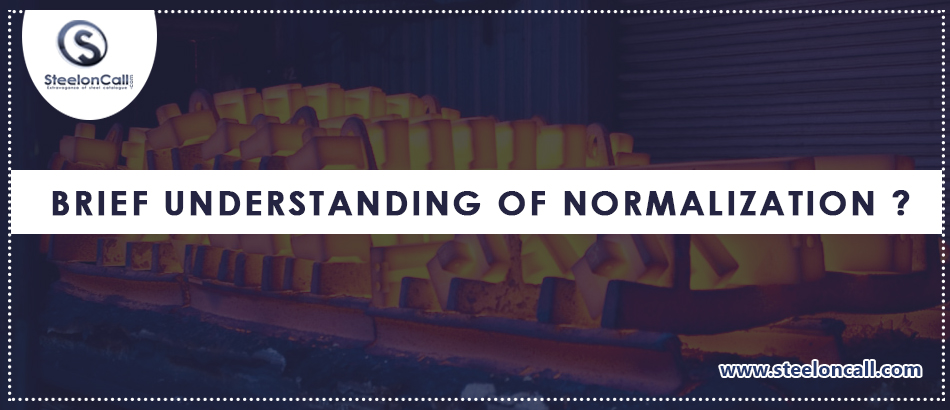
Normalization plans to give the steel a uniform and fine-grained structure. The procedure is utilized to get an anticipated microstructure and an affirmation of the steel's mechanical properties. Normalization is a heat treatment process that is utilized to make a metal more ductile and tough after it has been exposed to thermal or mechanical hardening processes. Normalization involves heating a material to a raised temperature and afterward enabling it to cool back to room temperature by presenting it to room temperature air after it is heated. This heating and moderate cooling adjusts the microstructure of the metal which in turn reduces its hardness and increases its malleability.
NORMALIZATION FACTORS:
- Ferritic stainless steel stampings in the industry of automotive that might be normalised after the work solidifying that happens during their shaping procedure.
- Carbon steel might be normalised after it is cold-rolled to reduce the fragility caused by work hardening.
PROCESS OF NORMALIZATION:
During normalizing, the material is heated to a temperature approximately equivalent to the solidifying temperature (800-920°C). At this temperature new austenitic grains are shaped. The austenitic grains are a lot smaller than the past ferritic grains. After heating and a short soaking time the segments are cooled unreservedly in air. During cooling, new ferritic grains are framed with a further refined grain size. In some cases, both heating and cooling occur under defensive gas to maintain a strategic distance from oxidation and decarburisation.
Cold working and casting are fabricating forms that produce grain structures that may require normalization before the segment is placed into administration. Normalizing relieves internal stresses caused by cold work. The resultant fine grain structure after normalizing is stress free and the mechanical properties generally show improved ductility. a decrease in hardness and expanded in general sturdiness, for example, impact strength compared to cold work state.
BENEFITS OF NORMALIZATION:
- The normalization type of heat treatment is more affordable than annealing. Annealing is a heat treatment process that carries metal more like a condition of equilibrium. In this state, the metal gets softer and easier to work with. Annealing requires slow-cooling, metal to permit its microstructure to change. It is heated above its basic point and permitted to cool gradually, much slower than during the normalization process.
- Heat Treatment for any kind of metal one can think of. Normalising is used to consider. Normalizing is utilized to improve the mechanical properties, unalloyed and low-alloy structural steel and cast steel. This heat treatment makes a better structure in the material, subsequently supporting both its tensile strength and its ductility, just as limiting the inner pressure. Basically, normalizing the steel implies returning prepared steel to its ordinary state.
APPLICATION OF NORMALIZING
Normalizing is the most broadly utilized mechanical procedure since it is progressively efficient to standardize the steel as against annealing. In normalizing since the cooling happens in air, the heater is prepared for the next cycle when heating and soaking is over as compared to annealing where heater cooling after heating and soaking needs 8-20 hours depending upon the amount of charge. Thus much of the time annealing is replaced by normalizing to decrease the expense of heat treatment. Normalizing is received if the properties necessities are not basic.
Normalising differs from annealing in the subsequent cooling, for example in still air, instead of a heater cool. The hardenability of a low carbon mild steel is low. However, when looking at the composition of ordinary carbon steels, silicon levels of 0.2 percent and manganese levels of 0.7 percent, according to the '25' C, are not unusual.
Need a price for your requirement?
Share your grade, diameter and quantity — our steel experts come back with a live quote and delivery timeline.