
SteelonCall Journal
Overview Of TMT Steel And How They Made
Thermo-mechanically treated bars (TMT bars) are generally utilized for various construction projects. Made from high strength steel, TMT bars have a few characteristics that make them the most favored material for different construction projects.
Steeloncall
25 May 2020 · 3 min read
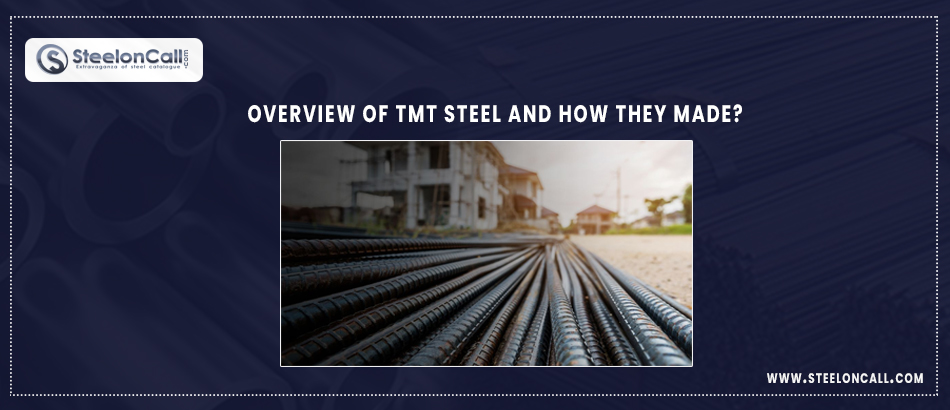
Thermo-mechanically treated bars (TMT bars) are generally utilized for various construction projects. It is made from high strength steel TMT Steel bars have a few characteristics that make them the most favored material for different construction projects.
THE MANUFACTURING PROCESS OF TMT BAR:
TMT bars are high-quality reinforcement bars having a tight outer core and a soft inner core. The simple initial step of the manufacturing process includes passing the steel wires through a moving plant stand. From there on, these rolled steel wires are again gone through the temperature core water cooling framework; While going through the wires through the water cooling framework, the water pressure is enhanced. The unexpected quenching and drastic change in temperature toughen the external layer of the steel bar, making it overly intense and robust. When this procedure completes, the TMT Steel bars are dependent upon air cooling. It's done to level the temperature distinction between the soft inner core and the tough exterior. Once the TMT bar cools down, it gradually transforms into a ferrite-pearlite mass. The inward center stays delicate, invigorating the TMT bar incredibly malleable and prolonging the point. This structure is extraordinary to the TMT bars and gives better flexibility than the bars. Additionally, this unique manufacturing technique and the absence of cold stress make this bar corrosion-resistant and boost its weldability.
ADVANTAGES OF TMT BARS
- The latest technology with TMT bars
- Unique design
- Earthquake resistant TMT bar
- Superior bendability
- Resistant to fatigue
- Strong
- Corrosion resistance
- Weldability
Thermomechanical treatment involves three essential steps that are:
- Quenching
- Self tempering
- Atmospheric cooling
QUENCHING
The hot roll bars discharge and enter the water splash framework called 'Thermex system'. Thermex technology is utilized in the manufacturing process of the best quality TMT Steel bars. This technology cools down the external center quickly and, in this manner, guarantees the malleability of TMT rebar. Rapid cooling hardens the outer surface of TMT rebar, framing a marten's tic edge. At the same time, the center keeps on staying hot and real. This cooling method is known as 'quenching.'
SELF TEMPERING
When TMT Steel rebar is out of quenching, the center stays hot when contrasted with the outside of the rebar. It permits heat to spill out of the center to the surface, which prompts the hardening of the external layer, at last framing a structure called 'tempered martensite.'
ATMOSPHERIC COOLING
When the procedure of self-tempering gets over, the TMT bar prepares for climatic cooling. This cooling happens on a cooling bed in ordinary temperatures. Under this progression, the authentic center transforms into the ferrite-pearlite structure.
APPLICATION OF TMT BARS
- TMT bars find their application in many avenues.
- Bridges
- Dams
- High-rise apartments
- Industrial structures
- Flyovers
- It is highly pure, which invigorates it upgraded and solid.
- It bonds flawlessly with concrete, on account of its top tier rib design with the most noteworthy ar esteem. That implies more versatility to any burden.
- It is profoundly impervious to quakes, because of a mix of higher quality and malleability. A high UTS/YS proportion of 1.15 least raises its ability to assimilate vitality.
- TMT Steel bars are effectively weldable because of its low carbon content. It may very well be effectively butt-welded, lap-welded, and manual circular segment welded, without any pre-heating.
- It is highly anti-corrosive, because of its one of a kind, uniform microstructure and the nonattendance of residual stresses.
- It is likewise effectively bendable, because of its innate microstructure with a delicate ferrite and pearlite center.
FEATURES OF TMT BARS
TMT steel rebars are, as of now, the most utilized steel reinforced bar in the construction field. They are known for their high elasticity and malleability. There are various grades for TMT rebars, namely Fe 415, Fe 500, Fe 550, Fe 600. Before TMT rebars, other steel rebars, for example, mild steel, HYSD preparations were utilized as reinforcements to concrete, yet these steel rebars didn't have the adequate elasticity; in this way, TMT steel rebars came to market.
Need a price for your requirement?
Share your grade, diameter and quantity — our steel experts come back with a live quote and delivery timeline.