
SteelonCall Journal
Steel Pipe Dealers in Hyderabad: Types, Sizes, Applications, Prices & Buying Guide
Steeloncall
17 August 2026 · 10 min read
On this page
- Quick Answer
- Types of Steel Pipes Available in Hyderabad
- MS Pipes
- GI Pipes
- ERW Pipes
- Seamless Steel Pipes
- Square and Rectangular Steel Pipes
- Common Steel Pipe Sizes
- Steel Pipe Applications in Hyderabad
- How to Choose Steel Pipe Dealers in Hyderabad
- Factors Affecting Steel Pipe Prices in Hyderabad
- Steel Pipe Weight Calculation
- Why Buy Steel Pipes Online in Hyderabad?
- Why Choose SteelonCall for Steel Pipes in Hyderabad?
- Steel Pipe Buying Checklist
- Conclusion
- FAQs
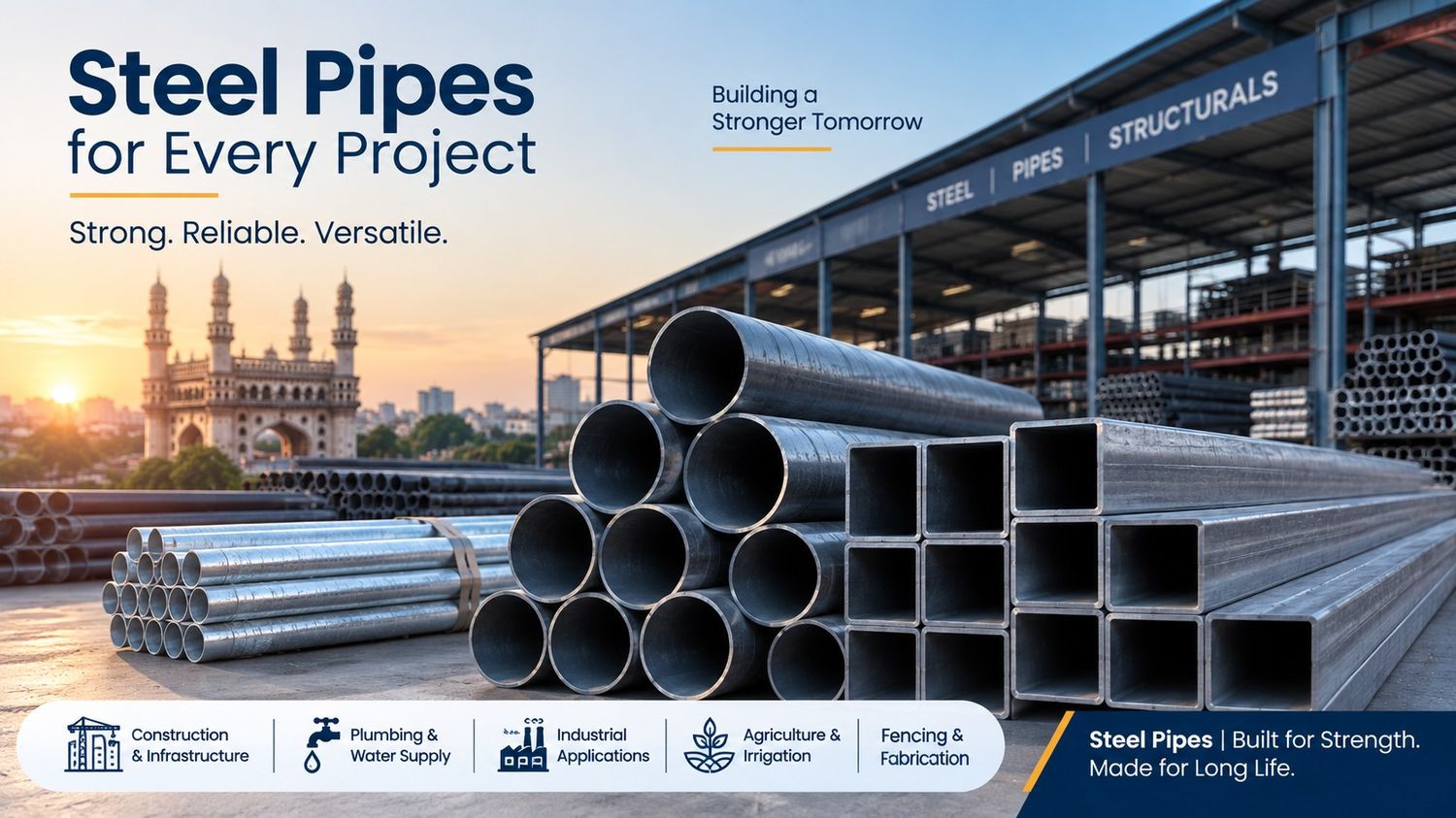
Steel pipes are widely used across construction, fabrication, infrastructure, manufacturing, plumbing, agriculture, and industrial projects. Depending on the application, buyers may requireMS pipes, GI pipes, ERW pipes, seamless pipes, square pipes, or rectangular hollow sections in different sizes and thicknesses.
If you are searching for Steel Pipe Dealers in Hyderabad, choosing the right supplier is important for ensuring that the material matches your project's technical requirements. Price is only one part of the decision—pipe type, diameter, wall thickness, grade, brand, quantity, quality documentation, and delivery should also be considered.
This guide explains the major types of steel pipes, their applications, common sizes, factors affecting prices, and how to choose a reliable steel pipe dealer in Hyderabad.
Quick Answer
Steel Pipe Dealers in Hyderabad supply different types of steel pipes, including MS, GI, ERW, seamless, square, and rectangular pipes for construction, fabrication, plumbing, infrastructure, and industrial applications. Before purchasing, verify the pipe type, diameter, wall thickness, grade, length, applicable standard, quantity, and delivery requirements. SteelonCall helps customers source steel pipes with competitive quotations and delivery assistance across Hyderabad.
Types of Steel Pipes Available in Hyderabad
Different applications require different pipe designs and manufacturing methods. Understanding the basic categories can help you select a suitable product.
| Steel Pipe Type | Common Applications | Main Advantage |
| MS Pipes | Construction, fabrication, general engineering | Versatile and economical |
| GI Pipes | Plumbing, water supply, fencing | Zinc-coated corrosion protection |
| ERW Pipes | Construction, structural applications, engineering | Consistent dimensions and availability |
| Seamless Pipes | High-pressure and demanding applications | No welded seam |
| Square Pipes | Frames, gates, sheds, fabrication | Easy structural fabrication |
| Rectangular Pipes | Buildings, structures, machinery | Efficient structural sections |
The right pipe should be selected according to the project's design, loading, pressure, environment, and applicable technical specifications.

MS Pipes
Mild Steel (MS) pipes are commonly used for fabrication, structural work, construction, and general engineering.
Their applications include:
- Structural frameworks
- Gates and railings
- Industrial fabrication
- Machinery structures
- Construction supports
- General engineering
MS pipes are available in different diameters and wall thicknesses, allowing suppliers to cater to different project requirements.
Where corrosion protection is required, MS pipes may need suitable painting, coating, or other protective treatment.
GI Pipes
Galvanized Iron (GI) pipes have a zinc coating that helps protect the underlying steel from corrosion.
They are commonly used in:
- Plumbing
- Water supply
- Irrigation
- Fencing
- Agricultural structures
- Utility applications
GI pipes can be useful where exposure to moisture is a concern. However, the required coating and pipe specification should be selected according to the application and applicable standard.
ERW Pipes
ERW (Electric Resistance Welded) pipes are manufactured by forming steel into a cylindrical shape and joining the edges through an electric resistance welding process.
They are widely used in:
- Structural applications
- Construction
- Engineering
- Water-related applications
- Fabrication
- Industrial projects
ERW pipes are available in a wide range of sizes and thicknesses, making them a common choice for construction and fabrication.
Seamless Steel Pipes
Unlike welded pipes, seamless pipes are manufactured without a longitudinal welded seam.
They are commonly considered for applications where the pipe must meet demanding pressure, temperature, or mechanical requirements.
Typical applications can include:
- Oil and gas
- Boilers
- Pressure systems
- Engineering applications
- Industrial equipment
For these applications, pipe selection should be based on the required pressure, temperature, material grade, applicable standard, and engineering specification.
Square and Rectangular Steel Pipes
Square and rectangular hollow sections are commonly used in structural and fabrication applications.
Square Pipes
Common applications include:
- Gates
- Railings
- Frames
- Furniture
- Sheds
- Structural fabrication
Rectangular Pipes
They are commonly used for:
- Structural frameworks
- Industrial sheds
- Building structures
- Machinery frames
- Fabrication
Their uniform shape makes them convenient for cutting, welding, and assembling fabricated structures.
Common Steel Pipe Sizes
Steel pipes are available in numerous diameters and wall thicknesses.
Common nominal pipe sizes include:
- ½ inch
- ¾ inch
- 1 inch
- 1¼ inch
- 1½ inch
- 2 inch
- 2½ inch
- 3 inch
- 4 inch
- 5 inch
- 6 inch
- 8 inch and above
Square and rectangular pipes are specified using their outside dimensions and wall thickness.
The appropriate size should not be selected only according to availability. For structural or pressure applications, the engineer's specification should determine the required dimensions.
Steel Pipe Applications in Hyderabad
Steel pipes are used across a wide range of projects in Hyderabad.
Construction
Applications include:
- Structural supports
- Scaffolding
- Railings
- Gates
- Industrial sheds
- Building frameworks
Plumbing and Water Supply
GI and other suitable steel pipes can be used for:
- Water distribution
- Plumbing systems
- Utility lines
- Irrigation
Industrial Projects
Steel pipes are used in:
- Manufacturing plants
- Engineering facilities
- Machinery
- Process systems
- Industrial structures
Fabrication
Fabricators commonly use steel pipes for:
- Gates
- Railings
- Frames
- Furniture
- Storage structures
- Equipment supports
Infrastructure
Steel pipes can also be used in infrastructure-related applications depending on their grade, specification, and design requirements.
How to Choose Steel Pipe Dealers in Hyderabad
Choosing the right dealer can help avoid problems related to incorrect specifications, material availability, and project delays.
1. Check the Pipe Specification
Before requesting a quotation, clearly specify:
- Pipe type
- Diameter or section size
- Wall thickness
- Grade
- Length
- Quantity
- Application
A detailed requirement allows suppliers to provide more accurate quotations.
2. Verify the Brand and Manufacturer
For projects where consistent quality is important, consider established manufacturers and verify the product details supplied.
3. Check Quality Documentation
Depending on the application, ask whether relevant material certificates or test documentation are available.
For critical applications, documentation should be checked against the project's requirements.
4. Compare the Complete Cost
Don't compare suppliers based only on the quoted steel rate.
Consider:
- Material price
- Taxes
- Transportation
- Loading and unloading
- Delivery charges
- Other applicable costs
5. Check Stock Availability
Confirm whether the required size, thickness, grade, and quantity are readily available.
6. Evaluate Delivery
For construction and industrial projects, timely delivery can be as important as price.
Choose a supplier who can meet your required delivery schedule and location.
Factors Affecting Steel Pipe Prices in Hyderabad
The steel pipe price in Hyderabad changes according to several factors.
Steel Market Prices
Changes in raw material and steel market conditions can influence pipe prices.
Pipe Type
MS, GI, ERW, seamless, and other pipe types have different manufacturing processes and costs.
Diameter and Thickness
Larger and thicker pipes generally contain more steel and therefore have a higher material cost.
Grade
Special grades designed for specific applications may cost more than standard grades.
Brand
Prices can vary between manufacturers depending on specification, availability, and market demand.
Quantity
Bulk orders may have different commercial terms compared with smaller purchases.
Transportation
The final delivered price can depend on the distance between the supplier and project location.
How to Compare Steel Pipe Prices
For an accurate comparison, ask different dealers for quotations based on the same pipe type, size, thickness, grade, brand, quantity, taxes, and delivery terms.
This prevents a lower quotation from appearing cheaper simply because it covers a different specification.
Steel Pipe Weight Calculation
Steel pipes are often purchased based on weight, length, or number of pieces depending on the product and supplier.
For a circular pipe, theoretical weight can be estimated from:
Weight per metre = π/4 × (D² − d²) × density
Where:
- D = outside diameter
- d = inside diameter
- Density = density of steel
For practical procurement, it is better to refer to the manufacturer's weight tables or applicable standards because actual dimensions and permissible tolerances can affect the final weight.
When requesting quotations, confirm whether the price is quoted:
- Per kg
- Per metre
- Per pipe
- Per tonne
This makes price comparison much easier.
Steel Pipe vs GI Pipe: Which Should You Choose?
The right choice depends on the application.
| Factor | MS/Steel Pipe | GI Pipe |
| Surface | Generally uncoated | Zinc coated |
| Corrosion Protection | Requires suitable protection where needed | Better surface corrosion protection |
| Fabrication | Widely used | Suitable for many applications but coating may affect fabrication |
| Common Uses | Structural & fabrication | Plumbing, water supply & fencing |
| Cost | Generally economical | Higher due to galvanizing |
Neither product is universally better. The selection should be based on the project's environment, design, fabrication requirements, and budget.
Why Buy Steel Pipes Online in Hyderabad?
Traditional steel procurement can involve contacting multiple dealers, checking availability, comparing quotations, and arranging transportation.
Online procurement can simplify this process.
Customers can:
- Submit their exact requirements
- Request quotations
- Compare available options
- Check product specifications
- Place bulk enquiries
- Coordinate delivery
- Get procurement assistance
This can save time for builders, contractors, fabricators, manufacturers, and businesses with recurring steel requirements.
Why Choose SteelonCall for Steel Pipes in Hyderabad?
SteelonCall helps simplify steel procurement by providing customers with access to construction, fabrication, and industrial steel products.
Benefits of Choosing SteelonCall
- Steel pipe enquiries
- Multiple steel products and brands
- Competitive quotations
- Bulk order assistance
- Transparent procurement
- Expert product guidance
- Delivery assistance across Hyderabad
- Customer support
Whether you need MS pipes, GI pipes, ERW pipes, seamless pipes, square pipes, or rectangular pipes, SteelonCall can help you source material according to your project requirements.
Steel Pipe Buying Checklist
Before confirming your purchase, check:
✔ Pipe type
✔ Diameter or section dimensions
✔ Wall thickness
✔ Grade
✔ Length
✔ Brand/manufacturer
✔ Applicable standard
✔ Quantity
✔ Quality documentation, where required
✔ Price per kg/metre/piece
✔ Taxes and transportation
✔ Delivery schedule
Following this checklist can help you make a more informed decision when comparing Steel Pipe Dealers in Hyderabad.
Conclusion
Finding reliable Steel Pipe Dealers in Hyderabad is important for construction, fabrication, plumbing, infrastructure, and industrial projects. From MS and GI pipes to ERW, seamless, square, and rectangular sections, the right product depends on the project's technical and environmental requirements.
Before purchasing, compare suppliers based on product specification, grade, dimensions, quality, brand, price, availability, documentation, and delivery rather than choosing only the lowest quotation.
SteelonCall helps builders, contractors, fabricators, manufacturers, and businesses simplify steel procurement by providing access to multiple steel products and brands, competitive quotations, bulk order support, and delivery assistance across Hyderabad.
FAQs
1. What types of steel pipes are available in Hyderabad?
Common options include MS pipes, GI pipes, ERW pipes, seamless pipes, square pipes, and rectangular pipes. Availability depends on the supplier, manufacturer, size, and specification.
2. What are steel pipes used for?
Steel pipes are used in construction, structural fabrication, plumbing, water supply, industrial projects, agriculture, infrastructure, machinery, and engineering applications.
3. What factors affect steel pipe prices in Hyderabad?
Prices depend on pipe type, diameter, wall thickness, grade, brand, quantity, current steel market conditions, transportation, taxes, and delivery location.
4. How do I choose a reliable steel pipe dealer?
Look for suppliers offering the required specifications, genuine products, transparent quotations, quality documentation where applicable, adequate stock, and reliable delivery.
5. What is the difference between ERW and seamless pipes?
ERW pipes are manufactured by forming steel and welding the edges using electric resistance welding. Seamless pipes are produced without a longitudinal welded seam and are commonly selected for applications with specific pressure or mechanical requirements.
6. Are GI pipes better than MS pipes?
Not necessarily. GI pipes provide zinc-coated corrosion protection, while MS pipes are widely used for fabrication and structural applications where suitable surface protection can be applied. The appropriate option depends on the application.
7. Can I buy steel pipes online in Hyderabad?
Yes. Customers can submit their requirements online, request quotations, compare options, and arrange delivery through steel procurement platforms.
8. Why buy steel pipes from SteelonCall?
SteelonCall provides access to multiple steel products and brands, competitive quotations, bulk order support, procurement assistance, and delivery support across Hyderabad.
Need a price for your requirement?
Share your grade, diameter and quantity — our steel experts come back with a live quote and delivery timeline.