
SteelonCall Journal
Tata Tiscon Rod Weight Chart for Reliable Construction
Get the complete Tata Tiscon rod weight chart for accurate RCC planning. Compare diameters, grades, and on-site checks to ensure reliable construction decisions
Steeloncall
20 December 2025 · 9 min read
On this page
- Key Takeaways
- Tata Tiscon Rod Weight Chart
- TMT Bar Weight Calculation Formula
- Why Weight Charts Matter in Construction Planning
- How to Choose the Right Tata Tiscon Grade for Your Project
- Factors That Affect TMT Bar Weight Accuracy
- How to Verify Genuine Tata Tiscon Steel
- Where to Buy Tata Tiscon Rods (With Reliable Delivery)
- Conclusion
- FAQs
Tata Tiscon rods are engineered for projects where structural reliability, dimensional precision, and consistent mechanical performance cannot be compromised. In reinforced concrete design, the weight of each bar diameter directly influences steel consumption, load distribution, bending schedules, and overall RCC behavior under stress. When the weight is accurate, quantity takeoffs stay precise, reinforcement detailing holds, and project budgets remain controlled. When it is not, even a small deviation can alter spacing, increase dead load, or trigger procurement shortages mid-execution.
This blog presents a complete, diameter-wise Tata Tiscon rod weight framework designed for field engineers and decision-makers who need dependable data for structural planning. You’ll find clarity on how weights vary across diameters, how these variations affect reinforcement strategy, and what professionals should verify before selecting the right Tiscon product for high-demand applications.
Key Takeaways
-
Rod weight accuracy is a structural variable, not a convenience, because it influences load paths, reinforcement spacing, bending schedules, and total steel consumption across RCC elements.
-
Tata Tiscon’s standardized diameters and tight tolerances reduce estimation drift, allowing project teams to prepare more accurate BOQs, control budgets, and avoid mid-cycle reinforcement shortfalls.
-
The D²/162 formula remains the fastest on-site validation method, enabling engineers to cross-check supplier deliveries and reject underweight or non-compliant bars before placement.
-
Authenticity checks like brand markings, heat numbers, BIS codes, rib pattern consistency, and field tests ensure that only verified Tata Tiscon steel enters critical structural zones.
Tata Tiscon Rod Weight Chart
Tata TMT bars are manufactured in multiple grades to meet different structural load requirements. These grades reflect variations in tensile strength, yield strength, and elongation capacity, allowing engineers to specify the right bar for seismic zones, high-load frameworks, or general RCC work. The most commonly used grades include Fe 500, Fe 550, and Fe 600, each suitable for projects with increasing demands on strength and durability.
Below is the standard diameter-wise weight chart used for planning reinforcement quantities, calculating steel consumption, and preparing bending schedules.
| Diameter (mm) | Weight (kg/m) |
|---|---|
|
8 mm |
0.395 kg |
|
10 mm |
0.617 kg |
|
12 mm |
0.888 kg |
|
16 mm |
1.580 kg |
|
20 mm |
2.470 kg |
|
25 mm |
3.850 kg |
|
32 mm |
6.310 kg |
|
40 mm |
9.860 kg |
TMT Bar Weight Calculation Formula
Although standard charts are widely used, engineers often verify values manually using the universal steel bar weight formula.
Standard Formula
Weight (kg/m) = (D² / 162)
Where D is the diameter in millimeters.
How It Works in Practice
-
8 mm bar → (8² / 162) ≈ 0.395 kg/m
-
10 mm bar → (10² / 162) ≈ 0.617 kg/m
-
12 mm bar → (12² / 162) ≈ 0.888 kg/m
These values align with the standard Tata Tiscon weight chart, allowing site engineers to cross-check weights during procurement, inspection, or material reconciliation.
Related: How to Calculate TMT Bar Weight: A Simple Guide
Why Weight Charts Matter in Construction Planning
Accurate steel weight data is central to structural planning and cost control. A verified weight chart ensures every aspect of reinforcement design aligns with engineering intent and project constraints.
1. Budget Estimation Accuracy
Steel accounts for a significant portion of RCC costs. When weights are precise, quantity takeoffs match actual site requirements, reducing cost drift and keeping procurement aligned with approved budgets.
2. Reinforcement Density Matching
Different structural elements demand specific reinforcement densities to satisfy load, shear, and bending requirements. Using accurate bar weights ensures that spacing, diameter selection, and lap lengths are maintained without unintended deviations from the design.
3. Safety and Structural Stability
Incorrect bar weights can affect load distribution and mechanical behavior, especially in seismic or high-load zones. Maintaining accurate weight data helps preserve the intended structural stiffness, ductility, and moment capacity.
4. Preventing Over-Ordering or Under-Ordering
Projects lose time and money when steel is ordered in excess or falls short during execution. Weight charts help procurement teams estimate exact quantities, plan deliveries efficiently, and avoid delays caused by mid-cycle shortages or surplus stock.
How to Choose the Right Tata Tiscon Grade for Your Project
Tata Tiscon offers multiple reinforcement grades designed for different structural demands. Selecting the correct grade requires understanding load behavior, ductility requirements, seismic considerations, and the type of RCC element being designed.
The sections below break down each grade and its ideal applications so engineers and procurement teams can make informed choices.
Fe 500D
Fe 500D provides higher ductility than Fe 500, reducing the risk of brittle failure. This grade is preferred when the structure requires better bending performance or must withstand moderate seismic activity.
Best for:
-
Mid-rise residential and commercial projects.
-
Areas with moderate seismic risk
-
Complex bar bending schedules
-
Reinforcement zones with tight hooks, bends, or development lengths.
Fe 550D
Fe 550D is designed for structures that require higher yield strength combined with enhanced ductility. This grade allows engineers to achieve stronger reinforcement performance without increasing bar diameters, making it suitable for areas where both load resistance and deformation capacity are critical. Its mechanical profile supports efficient reinforcement layouts while maintaining safety margins under seismic and dynamic loads.
Best for:
-
High-rise residential and commercial projects.
-
RCC elements that are subjected to higher axial and lateral loads.
-
Moderate to high seismic zones that require improved ductile behavior.
-
Heavily reinforced components like columns, beams, and raft foundations.

Factors That Affect TMT Bar Weight Accuracy
Several factors can influence the final weight of a bar, especially during manufacturing and storage.
Manufacturing Tolerance
TMT bars are produced with permissible dimensional variations defined under BIS standards. Minor differences in diameter, ovality, or rib height can influence weight per meter. Reputed manufacturers maintain tighter tolerances to ensure consistent performance across batches.
Grade and Rib Design
Higher-grade TMT bars often feature different rib patterns and optimized cross-sectional geometry to improve bonding strength. These variations add or reduce marginal weight, which is why bars of the same diameter may show slight differences across grades or brands.
Moisture, Rusting, and Storage Conditions
Bars stored in open yards can absorb moisture, accumulate rust, or retain surface deposits. While the change is small, it can impact cumulative weight during bulk procurement. Proper stacking, ventilation, and covered storage help maintain weight integrity and prevent corrosion-related losses.
Related: Diameter of Steel Bars: Sizes, Pricing & Buying Guide
How to Verify Genuine Tata Tiscon Steel
Authenticating Tata Tiscon steel is essential for ensuring structural safety, consistent performance, and compliance with engineering specifications. Counterfeit or under-quality bars can compromise load-bearing capacity and long-term stability. The following checks help confirm material authenticity.
Brand Markings
-
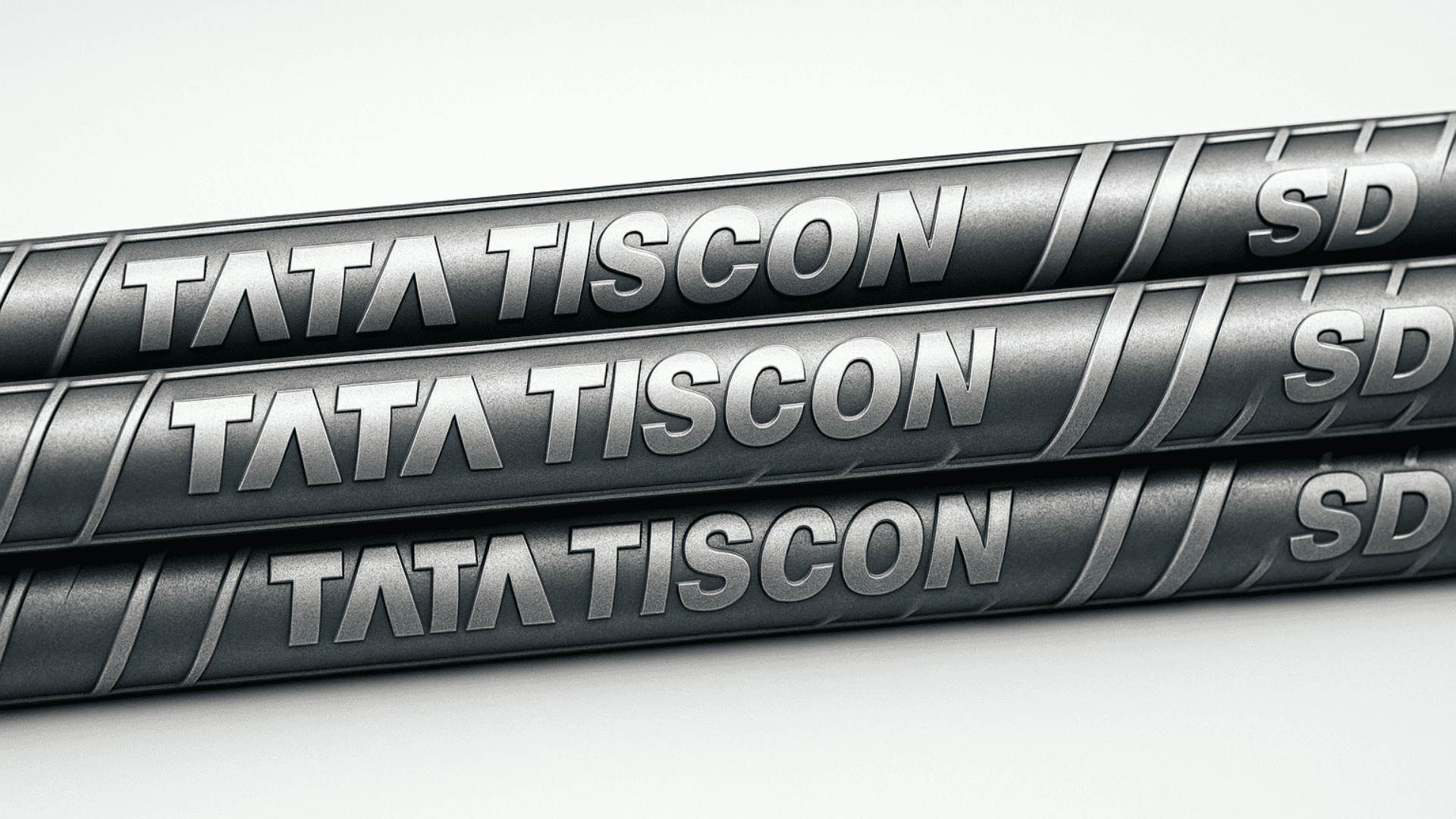
Look for clean, deeply rolled markings reading “TATA TISCON” along the bar length.
-
Check that the grade (Fe 500, Fe 500D, 550SD) is included.
-
Inspect multiple bars, not just the top layer of a bundle, to ensure consistency.
Heat Numbers
-
Locate the heat number on the bundle tag attached by the manufacturer.
-
Match the heat number with the mill test certificate (MTC) provided by the supplier.
-
Confirm that the chemical and mechanical properties in the MTC correspond to the grade ordered.
BIS Certification
-
Check for BIS markings as prescribed under IS 1786 on the bar surface.
-
Ensure the marking includes the IS standard, manufacturer code, and grade.
-
Reject bars with faded, inconsistent, or missing BIS stamps.
Testing Methods
-
Weight check: Weigh a sample bar and compare with standard chart values to identify undersized or oversized rods.
-
Bend test: Bend a representative sample to 180 degrees to ensure the bar doesn’t crack or show brittle behavior.
-
Rib pattern check: Verify that the ribs are uniform and match the typical Tata Tiscon pattern; inconsistent ribs often indicate counterfeit products.
-
Lab tests (for critical projects): Send samples for tensile, elongation, and chemical composition testing to validate compliance with IS 1786.
Also read: Steel Test on Site: 10 Essential Tests for TMT Bar Quality Assurance.
Where to Buy Tata Tiscon Rods (With Reliable Delivery)
Reliable material access is as important as choosing the correct TMT grade. Project teams need visibility into real-time stock, verified suppliers, and location-based availability before finalizing reinforcement orders. SteelonCall serves as an online marketplace where buyers can explore Tata Tiscon options across cities, compare prices, and review supplier listings without relying on a single vendor.
Why Engineers Use SteelonCall to Explore Tata Tiscon Options
-
Verified supplier listings: SteelonCall hosts listings from authorized distributors, allowing buyers to identify genuine Tata Tiscon products with accurate specifications and traceable documentation.
-
City-wise availability across grades and sections: Users can check Fe 500, Fe 500D, and 550SD TMT bars along with Tata’s structural sections based on what’s in stock in their region.
-
Real-time pricing and transparent comparison: The marketplace format enables contractors and procurement teams to compare prices, sizes, and grades from multiple suppliers before placing an order with the vendor they prefer.
-
Delivery and fulfillment handled by the listed suppliers: Buyers can view delivery timelines and service coverage offered by individual suppliers through the marketplace interface.
-
Support for infrastructure-scale needs: Large contractors benefit from seeing which suppliers can fulfill bulk quantities, handle repeated cycles, or support multi-location requirements.
Using an online marketplace ensures transparency, supplier choice, and regional availability, giving engineers confidence that the reinforcement they select aligns with project timelines and technical specifications.
Conclusion
Accurate weight data, grade selection, and material verification play a direct role in the strength, safety, and long-term performance of any RCC structure. Tata Tiscon’s standardized production and engineering-grade consistency make it a preferred choice for residential, commercial, and large-scale infrastructure projects. By using a reliable weight chart, validating authenticity, and choosing the correct grade for each structural element, project teams can maintain precision across estimation, reinforcement planning, and execution.
SteelonCall ensures that every Tata Tiscon bar delivered to your site is genuine, compliant, and ready for structural use. Whether you’re planning a home build, a commercial project, or a large infrastructure rollout, you can source all grades and sections with dependable logistics and full material traceability.
View city-wise Tata Tiscon stock on SteelonCall and choose the right grade and quantity based on real-time availability in your region.
FAQs
1. What is the standard Tata Tiscon rod weight chart used for?
It provides diameter-wise weights so engineers can estimate steel quantities, prepare accurate BOQs, and verify supplier deliveries on-site.
2. How do I manually calculate the weight of a Tata Tiscon bar?
Use the formula D²/162, where D is the diameter in millimeters. This helps confirm if delivered bars match standard weight values.
3. Which Tata Tiscon grade is best for high-rise construction?
Fe 500D and Fe 550D are typically preferred because of their higher yield strength and ductility, making them suitable for heavy loads and seismic detailing.
4. How can I verify if a Tata Tiscon bar is genuine?
Check brand markings, BIS codes, heat numbers on bundle tags, and perform basic on-site tests like weight checks, bend tests, and rib inspection.
5. Where can contractors buy Tata Tiscon bars with assured quality?
SteelonCall provides authorized Tata Tiscon supply with grade availability, real-time pricing, proper documentation, and project-based delivery support.
Need a price for your requirement?
Share your grade, diameter and quantity — our steel experts come back with a live quote and delivery timeline.