
SteelonCall Journal
Steel Unit Weight Chart: The Ultimate Procurement & Estimation Guide
Understand steel unit weight with our 10mm TMT rod guide. Calculate using D^2/162 formula, find rod and bundle weights, and ensure structural safety. Click for expert tips!
Steeloncall
14 January 2026 · 10 min read

On this page
- Key Takeaways:
- What Is the Unit Weight of Steel?
- Standard Formula for Calculating Steel Unit Weight
- Weight Charts (TMT, Structural Steel & Fabrication Weight Charts)
- TMT Bar Unit Weight Chart (Fe 500D / 550D)
- Practical Example: Calculating Steel Quantity for a Project
- How SteelonCall Digitizes Weight-Based Procurement
- Conclusion
- FAQs
Steel consumption in India reached 136 million tonnes in FY2024, reflecting massive construction demand and leaving little room for estimation errors on active sites. Even small mistakes in steel unit weight can trigger shortages, excess inventory, billing disputes, and stalled progress across contractors, fabricators, and project teams.
When you plan bulk steel purchases, you want confidence that quantities, deliveries, and costs will stay predictable from order placement to site usage. This guide helps you use steel unit weight charts and formulas to estimate accurately, avoid last-minute surprises, and keep construction work moving calmly.
Key Takeaways:
-
Steel unit weight fixes quantity, transport load, and billing accuracy.
-
All construction steel uses a density of 7850 kg/m³ for calculations.
-
Fe 500D and Fe 550D bars have the same weight; only the strength differs.
-
BIS tolerance allows for small weight variation, not an arbitrary short supply.
-
Weight-based procurement reduces disputes, delays, and cash blockage.
What Is the Unit Weight of Steel?
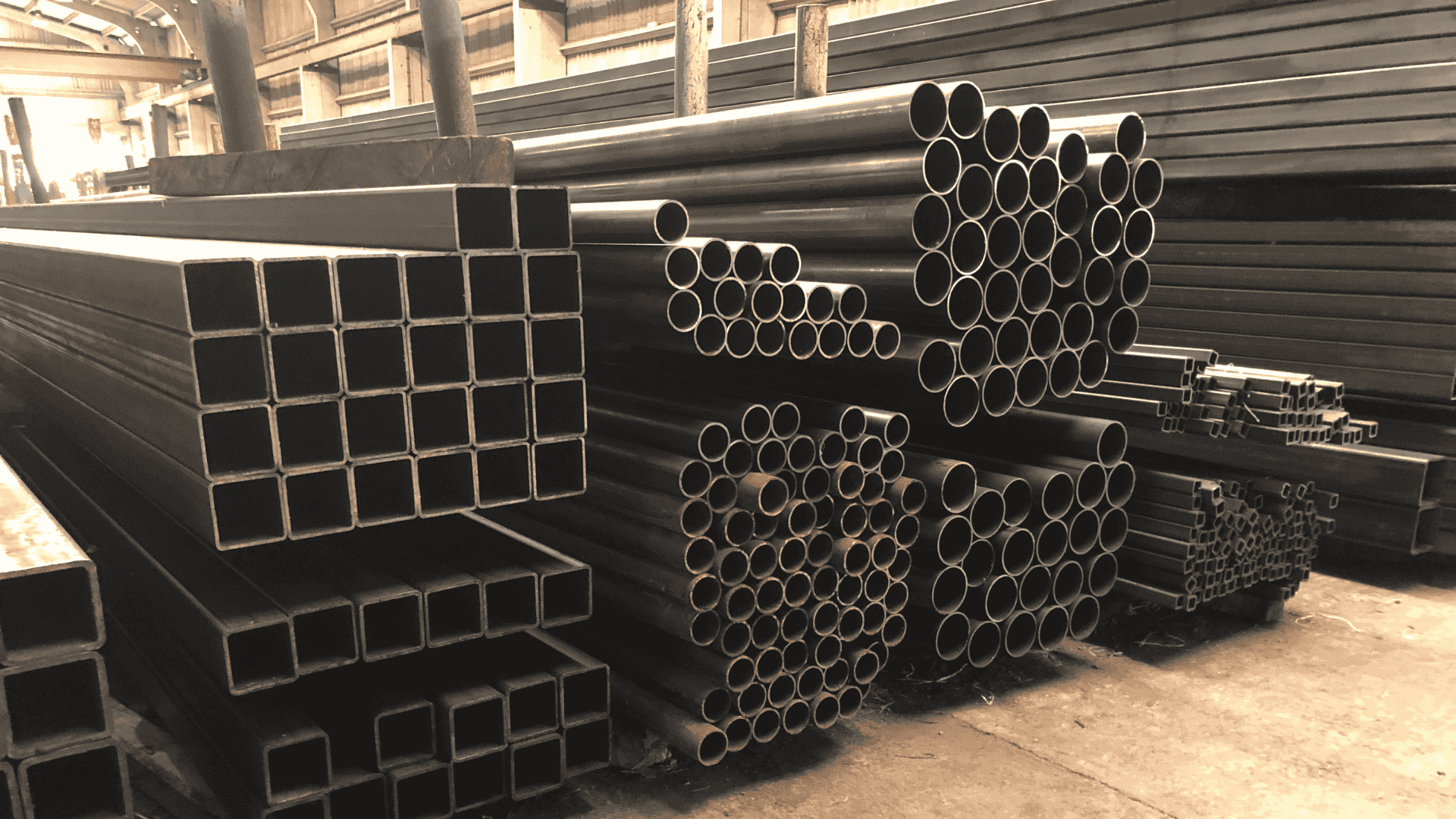
Steel unit weight refers to the weight of steel per standard unit, most commonly measured in kilograms per meter (kg/m) or kilograms per cubic meter (kg/m³). For construction and fabrication buyers, this value acts as a fixed reference for estimating quantities, validating invoices, and checking delivered material at the site.
Steel unit weight calculations are based on the standard density of steel, which is 7850 kg/m³. This density remains constant across construction-grade steel, making unit weight a reliable basis for planning costs, transport loads, and order quantities.
Misunderstanding unit weight often leads to excess ordering, short supply, or billing disputes. On large projects, even small per-meter errors can add up to several tonnes of mismatch.
How Steel Unit Weight Is Used by Buyers
Steel unit weight supports key decisions across construction and fabrication workflows.
-
Contractors and builders use it to estimate steel for slabs, beams, columns, and foundations before placing bulk orders.
-
Fabricators rely on it to plan cutting lengths, material usage, and transport loads for plates, pipes, angles, and channels.
-
Project managers and procurement teams apply it to verify supplier invoices against delivery challans and approved quantities.
A single, consistent unit weight reference helps maintain control over cost, schedule, and material accountability.
Unit Weight vs Total Steel Weight
Unit weight is the weight of steel per standard unit, such as kg per meter (kg/m) of bar. Total steel weight is calculated by multiplying the unit weight by the actual length, quantity, or volume used in the project.
Mixing these two values often causes ordering errors and billing disputes. Clear separation keeps procurement discussions factual and avoids unnecessary reconciliation issues.
Standard Formula for Calculating Steel Unit Weight
Steel unit weight formulas help convert dimensions on drawings into measurable quantities for ordering and billing.
On sites and fabrication floors, two formulas are used most often, based on steel shape.
Formula for Steel Bars and TMT Reinforcement
For round steel bars, including TMT bars, the standard formula used is:
Unit Weight (kg/m) = D² / 162
Here, D represents the bar diameter in millimeters.
Why 162? This is a mathematical simplification derived from the cross-sectional area (πr²) multiplied by the density of steel (7850 kg/m³). It is the quickest way to verify a bundle's weight during offloading.
Formula for Structural Steel Plates and Flats
For plates, flats, and sheets, unit weight depends on length, width, and thickness. The commonly used formula is:
Weight (kg) = L × W × T × 7.85
Where:
-
L = length in meters
-
W = width in meters
-
T = thickness in millimeters
-
7.85 represents steel density in kg/m³
This formula is useful for fabrication planning, transport load calculation, and material reconciliation.
Once you understand what unit weight means, you need clear formulas that convert diameters and dimensions into measurable quantities for ordering and billing.
Also Read: How to Calculate TMT Bar Weight: A Simple Guide
Weight Charts (TMT, Structural Steel & Fabrication Weight Charts)
Weight charts convert standard steel dimensions into ready reference values. They help buyers estimate quantities quickly, cross-check supplier invoices, and plan transport loads without recalculating each time.
Below are commonly used charts for construction and fabrication work:
TMT Bar Unit Weight Chart (Fe 500D / 550D)
For high-rise residential projects in Bengaluru and infrastructure work across Andhra Pradesh, Fe 500D and Fe 550D TMT bars are treated as fixed specifications. While these grades differ in ductility and yield strength, their unit weight remains identical, because weight depends only on diameter and steel density.
This distinction matters during procurement. Grade selection affects structural performance and pricing, while unit weight controls quantity estimation, billing checks, and delivery verification.
TMT Bar Unit Weight Reference Chart:
|
Nominal Diameter (mm) |
Weight per Metre (kg/m) |
Weight per 12 m Bar (kg) |
Approx. Bars per Tonne |
|
8 |
0.395 |
4.74 |
211 |
|
10 |
0.617 |
7.40 |
135 |
|
12 |
0.888 |
10.66 |
94 |
|
16 |
1.578 |
18.94 |
53 |
|
20 |
2.466 |
29.59 |
34 |
|
25 |
3.853 |
46.24 |
22 |
|
32 |
6.313 |
75.76 |
13 |
Contractors use this table to convert bar bending schedules into total tonnage before placing bulk orders. Project teams also rely on these values to cross-check truck loads and reconcile supplier invoices at the site.
Understanding Tolerance Limits (IS 1786:2008)
No steel bar matches its theoretical unit weight exactly. The Bureau of Indian Standards (IS 1786:2008) allows rolling tolerances within defined limits.
Permissible variation from theoretical unit weight:
-
8 mm to 10 mm bars: ±7%
-
12 mm to 16 mm bars: ±5%
-
20 mm diameter and above: ±3%
These tolerances apply to both 500D and 550D TMT bars. Knowing these limits helps buyers accept material confidently and avoid unnecessary disputes during joint measurement.
When steel is sourced from verified manufacturers such as Vizag Steel, rolling control stays closer to nominal values. Unverified local brands often roll closer to the negative tolerance, resulting in lower steel content per tonne and reduced section reliability.
Also Read: 12mm Steel Bar Length Chart: Check Vizag Steel 12mm Rod Details
Structural Steel & Fabrication Weight Charts
Structural steel behaves differently from TMT bars. Weight depends on section geometry, flange thickness, and web depth rather than diameter alone. Fabricators across South India use section weight references to plan material consumption and transport loads.
ISMB (Beams) and ISMC (Channels):
|
Section |
Depth (mm) |
Weight per Metre (kg/m) |
|
ISMB 100 |
100 |
8.9 |
|
ISMB 200 |
200 |
24.2 |
|
ISMC 150 |
150 |
16.4 |
|
ISMC 250 |
250 |
30.4 |
These values help estimate tonnage for frames, platforms, and industrial sheds.
MS Angle Unit Weight (ISA)
Angles form the backbone of trusses, bracing systems, and fabrication frames.
-
ISA 50 × 50 × 6 mm: 4.5 kg/m
-
ISA 75 × 75 × 6 mm: 6.8 kg/m
-
ISA 100 × 100 × 10 mm: 14.9 kg/m
Fabricators use these references for cutting plans, dispatch planning, and billing verification. Consistent use of standard charts keeps quantity checks clear from workshop to site.
Using standard weight charts together with tolerance limits keeps estimation, delivery checks, and billing aligned across teams.

Practical Example: Calculating Steel Quantity for a Project
Consider a mid-rise residential project where slab reinforcement uses 12 mm TMT bars in fixed lengths. The bar-bending schedule shows a total required bar length of 9,600 meters for one slab cycle.
From the standard weight chart, the unit weight of a 12 mm bar is 0.888 kg per meter.
To calculate the total steel quantity, multiply the total length by the unit weight.
9,600 m × 0.888 kg/m = 8,524.8 kg
This equals 8.52 tonnes of steel for that slab cycle. Procurement teams round this figure based on transport planning and rolling tolerance.
If bars are supplied in 12-meter lengths, divide the total length by the bar length.
9,600 ÷ 12 = 800 bars
Each 12-meter bar weighs 10.66 kg, which matches the chart value.
800 bars × 10.66 kg = 8,528 kg, which aligns with the earlier calculation.
For ordering, buyers usually add a small margin to cover cutting loss and site handling.
A 2–3 percent allowance is common for slab reinforcement.
With a 3 percent margin: 8.52 tonnes × 1.03 = 8.78 tonnes
This final figure becomes the booking quantity. During delivery, site teams verify truck weight, bar count, and bundle markings against this estimate.
Using this method keeps estimation, ordering, and billing aligned. It reduces last-minute short supply, excess stacking, and reconciliation delays during execution.
Also Read: How to Calculate Steel Quantity in Columns? Explained
How SteelonCall Digitizes Weight-Based Procurement
Weight-based steel procurement often breaks down when prices, quantities, or dispatch details change after booking, creating confusion during billing checks and site coordination. SteelonCall's digital marketplace improves this process by fixing weight, pricing, brand, and delivery terms early, helping you plan procurement with clarity and fewer on-site disputes.
Here are the key ways SteelonCall brings structure and predictability to weight-based steel purchasing:
-
Real-time GST-inclusive pricing: SteelonCall is the only platform showing real-time, GST-inclusive steel prices before booking, so you always know the final payable amount upfront.
-
Verified sellers only: Every listed seller is verified, reducing the risk of mixed lots, incorrect grades, or unclear material history during site receipt.
-
Price match assurance: When a verified lower quote is identified, price matching helps maintain rate consistency across repeat and bulk steel orders.
-
Planned dispatch: Dispatch schedules are planned in advance, reducing plant waiting time and keeping fabrication or construction work aligned with timelines.
-
Known steel brands: Steel is supplied from recognised brands, giving clear grade assurance for TMT bars, plates, beams, and structural sections.
-
Flexible payments: Multiple payment options support smoother cash flow management for large quantities and phased procurement requirements.
-
Quick support access: Quick support during booking and delivery tracking helps resolve issues early and avoids unnecessary work stoppages at the site.
Together, these measures keep steel quantities, pricing, and delivery commitments consistent from booking to site receipt. This gives you better control over procurement planning and fewer surprises during execution.
Conclusion
Accurate steel unit weight knowledge keeps estimation, ordering, and billing aligned across construction and fabrication work. When quantities stay predictable, projects avoid shortages, excess stock, and last-minute reconciliation issues at the site.
Clear charts, standard formulas, and tolerance awareness help buyers make confident decisions before placing bulk orders. This approach supports better planning, smoother delivery checks, and steady progress across every project stage.
If you want support with weight-based steel planning, verified sourcing, or bulk procurement, speak with SteelonCall experts today.
FAQs
1. Why does bundle weight vary between two trucks carrying the same diameter bars?
Bundle weight varies due to rolling tolerance, bar length variation, and bundle composition. Mills pack bundles by count, not exact weight. Two bundles with the same bar size can differ by several kilograms.
2. Should steel be verified by weighbridge weight or piece count at the site?
The weighbridge weight should be treated as the primary check. Piece count helps only when bar length and diameter are consistent. For billing clarity, weight confirmation always carries more authority than counting bars.
3. Does rust or surface scaling affect steel unit weight during delivery checks?
Light surface rust does not materially increase steel weight. Heavy scaling can add minor weight but usually stays within BIS tolerance. Rust is more of a quality concern than a weight concern.
4. How does cutting steel at the site affect the final reconciliation weight?
Cutting does not change the total steel weight, but it increases scrap and unusable length. Without tracking scrap separately, teams often assume a short supply when the issue is cutting losses.
5. Is GST calculated on theoretical weight or actual delivered weight?
GST applies to the invoiced quantity, which should match the actual delivered weight as per the weighbridge records. Any mismatch between invoice weight and delivery weight should be resolved before unloading.
Need a price for your requirement?
Share your grade, diameter and quantity — our steel experts come back with a live quote and delivery timeline.