
SteelonCall Journal
Steel Reinforced Concrete Slab Basics Contractors Must Know
Learn how a steel reinforced concrete slab works, how much steel is needed, and what affects slab quality and execution on site.
Steeloncall
14 January 2026 · 13 min read
On this page
- Key Takeaways:
- What Is a Steel Reinforced Concrete Slab?
- Types of Steel Reinforcement Used in Concrete Slabs
- Common Types of Reinforced Concrete Slabs in Buildings
- Design Fundamentals of Steel Reinforced Concrete Slabs For Contractors
- How Much Steel Is Typically Required for RCC Slabs?
- Common Mistakes Contractors Make While Planning Slab Steel
- Planning Steel Procurement for Concrete Slabs More Reliably
- How SteelonCall Supports Reliable Steel Buying for Slab Projects
- Conclusion
- FAQs
Concrete is the second-most-consumed material in the world after water, with more than 30 billion tonnes used every year. A significant portion goes into slabs, yet slab work is where construction projects face the most avoidable setbacks.
Cracks, steel shortages, delayed pours, and repeated site corrections slow progress and strain schedules. Most of these problems begin before concrete placement, driven by unclear slab understanding and weak steel planning. This blog explains how the right approach helps keep slabs strong and site work predictable.
Key Takeaways:
-
Slab issues often begin before concrete placement due to weak steel planning and unclear reinforcement understanding.
-
Knowing slab type and span direction helps avoid incorrect bar placement and steel shortages.
-
Planning-level steel estimates reduce last-minute purchases and casting delays.
-
Consistent reinforcement grades and sizes simplify fixing and inspection on site.
-
Early coordination between drawings, steel supply, and pour schedules keeps slab work predictable.
What Is a Steel Reinforced Concrete Slab?
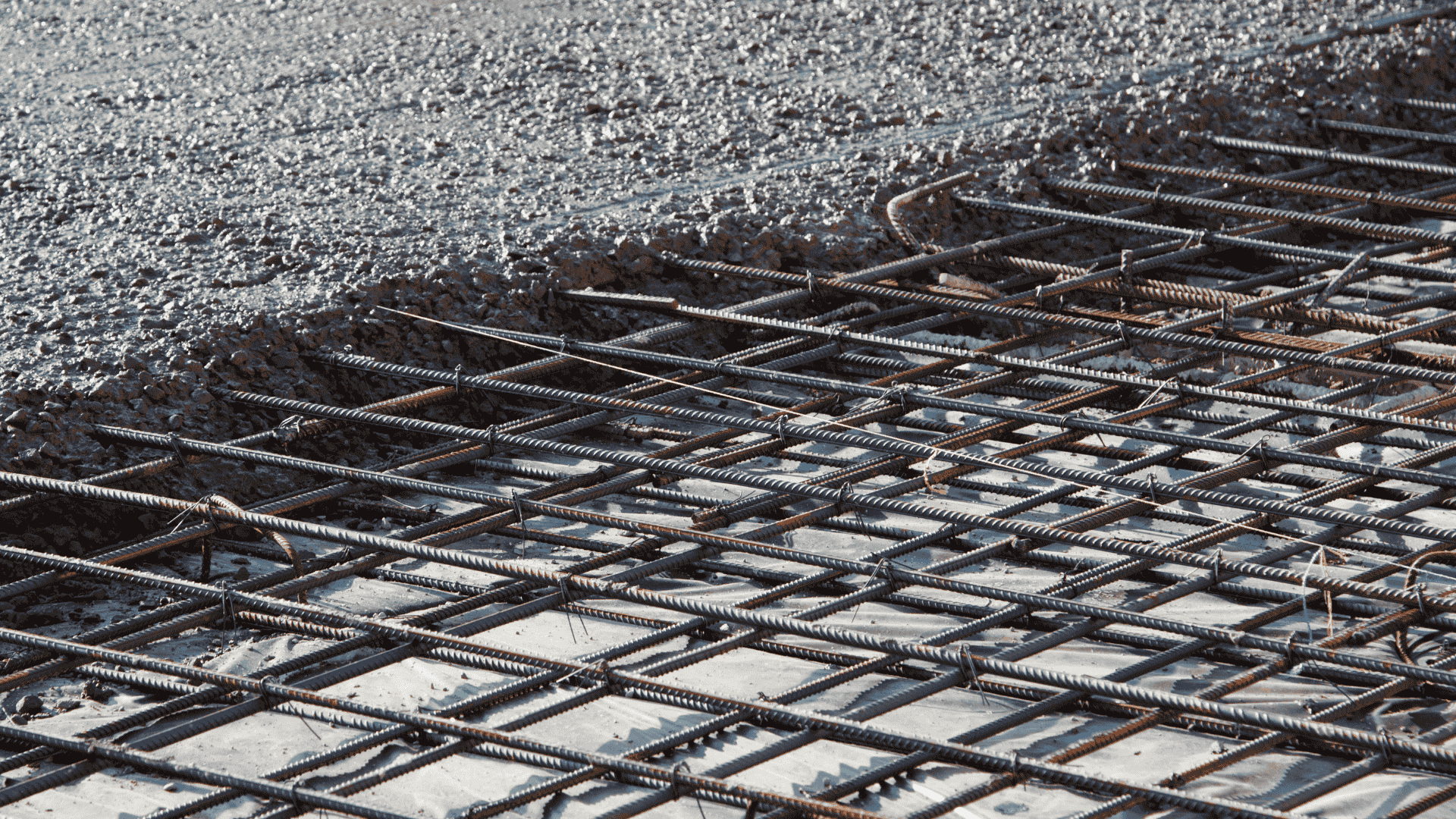
A steel-reinforced concrete slab is a flat structural element where concrete and steel work together to carry loads safely across floors and roofs. Concrete handles compressive forces, while embedded steel bars manage tensile stresses that develop during usage and over time.
Why Steel Is Used in Concrete Slabs?
Concrete performs well under compression but performs poorly when subjected to tension, bending, and shrinkage stresses common in slabs. Steel reinforcement compensates for this weakness, allowing slabs to remain stable under daily loads and long-term service conditions.
Here are the key reasons steel reinforcement becomes essential in slab construction:
-
Steel absorbs tensile forces that develop when slabs bend under loads from people, furniture, equipment, and structural elements above.
-
Reinforcement controls cracking caused by shrinkage and temperature changes, helping slabs retain structural integrity and surface quality.
-
Properly placed steel distributes loads more evenly across the slab, reducing localized stress concentrations and early deterioration risks.
-
Reinforced slabs achieve longer service life because steel limits deflection and prevents progressive damage under repeated loading cycles.
Knowing why steel matters leads to another practical question about which types of steel reinforcement are actually used in slabs.
Also Read: Slab Beam Reinforcement Detailing Guide
Types of Steel Reinforcement Used in Concrete Slabs
Several forms of steel reinforcement are used in slab construction, each serving a specific structural purpose. The choice depends on slab type, load conditions, span length, and execution practices followed on-site.
Here are the most commonly used types of steel reinforcement in concrete slabs and how they are typically applied:
|
Type of Reinforcement |
Common Use in Slabs |
Key Considerations on Site |
|
TMT Bars |
Primary load-bearing reinforcement |
Requires correct grade, spacing, and placement |
|
Welded Wire Mesh |
Crack control and secondary reinforcement |
Not suitable as the main reinforcement for slabs |
|
Mild Steel Bars |
Older or low-load applications |
Lower strength and ductility compared to TMT |
|
Binding Wire |
Holding bars in position during placement |
Does not contribute to structural strength |
Among these options, one reinforcement type has become the standard choice for most slab applications, especially in modern construction.
Why TMT Is the “Best” Choice for Slabs?
TMT bars are widely used in slab construction because they provide a reliable balance between strength, flexibility, and site handling requirements. Their consistent performance under bending and load makes them suitable for residential, commercial, and mixed-use slabs.
Here are the main reasons TMT bars are preferred for concrete slabs:
-
Higher strength capacity: TMT bars carry tensile forces effectively, allowing slabs to handle daily loads without excessive cracking or deflection.
-
Better ductility: The ability to bend without breaking helps slabs perform safely under stress and supports proper bar placement during execution.
-
Improved crack control: TMT reinforcement limits crack width caused by shrinkage and temperature variations over time.
-
Wider availability in standard grades: Common grades used for slabs are easier to source in bulk, reducing last-minute procurement issues.
-
Consistent site performance: Uniform bar properties help maintain predictable behavior across different slab panels and floors.
The type of reinforcement you choose often depends on the slab system being built, which varies across different building layouts.

Common Types of Reinforced Concrete Slabs in Buildings
Reinforced concrete slabs are classified based on how they carry loads and how reinforcement is arranged within the concrete. Understanding these slab types helps contractors anticipate steel quantity, bar layout, and execution complexity before work begins.
Here are the reinforced concrete slab types most commonly used in building construction:
-
One-way slab: Used when the slab span is longer in one direction, causing loads to transfer mainly along that span. Steel reinforcement is placed primarily in one direction.
-
Two-way slab: Applied when slab spans are nearly equal in both directions, allowing loads to distribute across two axes. Steel is placed in both directions, increasing reinforcement quantity.
-
Flat slab: A slab system supported directly by columns without beams, often used in commercial buildings. Reinforcement demand is higher around column areas.
-
Cantilever slab: Extends beyond its support, such as balconies or projections. Steel placement becomes critical due to bending stresses near the support.
-
Ribbed slab: Uses ribs to reduce concrete volume while maintaining load capacity. Reinforcement planning requires careful coordination due to varying slab thickness.
-
Slab on grade: Cast directly on the ground for floors at ground level. Reinforcement focuses on crack control rather than structural load transfer.
Each slab type follows a certain design logic, which contractors should understand to avoid execution errors during reinforcement work.
Also Read: Thumb Rule for Steel: Quick Guide for Slab, Beam & Column Calculations
Design Fundamentals of Steel Reinforced Concrete Slabs For Contractors
While slab design is done by structural engineers, contractors must understand these fundamentals to execute steel-reinforced concrete slabs correctly on site. This understanding supports better supervision, reduces corrections, and keeps slab work aligned with drawings and schedules.
Here are the design fundamentals that directly affect slab execution and steel planning:
Slab Span Logic: One-Way and Two-Way Reinforcement Basics
Slab behavior depends on how the slab spans between supports, which decides load flow and reinforcement direction. Recognizing this early prevents incorrect bar placement and material mismatch on-site.
Here is how slab behavior affects execution decisions:
One-way slabs:
- Load transfers mainly in one direction
- Main reinforcement runs along the shorter span
- Steel quantity remains relatively lower
Two-way slabs:
- Loads are distributed in two directions
- Main reinforcement runs both ways
- Steel quantity and fixing effort increase
How Slab Thickness and Loads Influence Steel Requirement
Slab thickness is linked to span length and the loads the slab must carry during its service life. Thicker slabs usually indicate higher load expectations and increased reinforcement demand.
Here are the practical site implications of slab thickness and load levels:
-
Residential floors generally require less steel
-
Parking and service areas require heavier reinforcement
-
Increased thickness leads to higher steel consumption and longer fixing time
Bar Diameter, Spacing, and Cover: Site Checks That Matter
Bar diameter, spacing, and cover control how the slab resists bending and cracking after concrete placement. Small deviations during fixing can reduce slab performance even when concrete strength is adequate.
Here are the execution checks that matter most on site:
-
Bar diameters match approved drawings
-
Spacing remains uniform across slab panels
-
Cover blocks are placed correctly to protect the reinforcement
How Steel Is Placed in Reinforced Concrete Slabs
Steel placement determines how effectively loads move through the slab during use. Proper placement maintains structural intent and reduces long-term service issues.
Here is how different reinforcement elements function within a slab:
|
Reinforcement Element |
Role in Slab |
|
Main bars |
Resist bending and tensile stresses |
|
Distribution bars |
Control cracking and spread loads |
|
Binding wire |
Holds bars in position during pouring |
Once design fundamentals are clear, attention naturally shifts toward estimating how much steel each slab is likely to require.
How Much Steel Is Typically Required for RCC Slabs?
Estimating steel quantity for an RCC slab depends on slab area, thickness, span, and expected load conditions. Since detailed structural drawings are not always available at early stages, contractors rely on thumb rules for preliminary budgeting and material planning.
These estimates help plan steel procurement, avoid shortages during slab casting, and reduce dependence on last-minute sourcing.
Thumb Rule Method for Slab Steel Estimation
For standard residential and commercial slabs, contractors often estimate steel based on built-up area. This approach provides a quick reference before final reinforcement drawings are issued.
Here is the commonly followed thumb rule for slabs:
-
Steel requirement: 3.5 kg to 4.5 kg per square foot of slab area
This range usually covers:
-
Main reinforcement bars
-
Distribution bars
-
Lapping and basic wastage allowance
Steel Requirement Table for Residential Slabs:
|
Slab Area (Sq. Ft.) |
Estimated Steel (kg) |
Estimated Steel (Metric Tons) |
|
500 |
1,750 – 2,250 |
1.75 – 2.25 |
|
1,000 |
3,500 – 4,500 |
3.50 – 4.50 |
|
1,500 |
5,250 – 6,750 |
5.25 – 6.75 |
|
2,000 |
7,000 – 9,000 |
7.00 – 9.00 |
Note: These values represent planning-level estimates and should not replace structural design quantities.
Also Read: Steel Required for 1000 Sq Ft Slab: Easy Calculation Guide
Volume-Based Method for Steel Estimation
Another common approach estimates steel as a percentage of concrete volume. In typical RCC slabs, steel content ranges between 0.8% and 1.0% of the total concrete volume.
This method is useful when the slab thickness and concrete quantity are already known during planning.
Basic parameters used:
-
Concrete volume in cubic meters
-
Steel percentage based on slab type
-
Steel density of approximately 7,850 kg per cubic meter
This method provides a closer estimate but still requires final design confirmation.
Factors That Increase Steel Consumption in Slabs
Steel requirement does not remain constant across all slabs. Certain conditions push consumption toward the higher end of thumb-rule ranges.
Key factors include:
-
Slab thickness: Thicker slabs require higher reinforcement to control bending and cracking
-
Clear span length: Longer spans demand additional steel to limit deflection
-
Seismic considerations: Areas with higher seismic demand require closer spacing and ductile grade bars
-
Cantilever slabs: Balconies and projections need top reinforcement, increasing steel quantity locally
Recognizing these factors early helps prevent underestimation during procurement.
Common Bar Diameters Used in Slab Construction
Steel weight in slabs is usually distributed across a few standard bar sizes.
Typical slab reinforcement includes:
-
Main bars: 10 mm or 12 mm TMT bars placed along the shorter span
-
Distribution bars: 8 mm or 10 mm TMT bars placed along the longer span
-
Chairs and supports: 8 mm bars used to maintain bar levels during concreting
Bar diameter selection directly affects total steel weight and fixing effort on site.
Steel Quantity Comparison Across RCC Members
Slabs generally consume less steel compared to other structural components in a building.
|
RCC Member |
Typical Steel Percentage (by Volume) |
|
Slabs |
0.7% – 1.0% |
|
Beams |
1.0% – 2.0% |
|
Columns |
1.0% – 5.0% |
|
Foundations |
0.5% – 0.8% |
Steel quantity alone does not prevent problems, as many delays stem from avoidable planning errors during slab preparation.
Common Mistakes Contractors Make While Planning Slab Steel
Slab steel planning often happens under time pressure, especially when project schedules are tight, and multiple trades are involved. Small planning gaps at this stage can create delays, rework, and cost escalation once execution begins.
Here are the most common mistakes contractors make while planning steel for slab work:
-
Underestimating steel quantity: Early estimates that ignore slab type, span length, or load conditions often lead to shortages during casting.
-
Ignoring slab-wise sequencing: Ordering steel without matching slab-wise pouring stages causes material congestion on site and uneven consumption.
-
Accepting unplanned brand substitutions: Switching steel brands due to availability issues introduces variation in bar properties and inspection concerns.
-
Late coordination with drawings: Ordering steel before final reinforcement drawings are approved increases the risk of bar size and spacing changes.
-
Poor allowance for lapping and wastage: Excluding overlap lengths and handling losses results in last-minute procurement pressure.
-
Weak delivery scheduling: Steel arriving too early occupies space, while late deliveries disrupt formwork and concrete booking timelines.
Avoiding these mistakes requires a more structured approach to steel procurement tied closely to slab execution schedules.
Planning Steel Procurement for Concrete Slabs More Reliably
Steel procurement directly affects slab timelines because reinforcement availability decides when fixing, inspection, and concrete placement can begin. Poor planning at this stage often creates avoidable pauses, rushed sourcing, and schedule strain across the site.
Here are practical steps contractors follow to plan slab steel procurement more reliably:
-
Link steel orders to slab-wise pour schedules: Plan quantities floor by floor so steel arrives close to execution dates without site congestion.
-
Confirm reinforcement drawings before ordering: Lock bar diameters, spacing, and quantities to avoid mid-course changes and surplus material.
-
Build a buffer for lapping and handling losses: Include overlap lengths and minor wastage to prevent last-minute shortages.
-
Match delivery timing with formwork readiness: Steel should reach the site only after shuttering and access are ready for fixing.
-
Track steel consumption after each slab: Monitoring actual usage helps correct estimates for upper floors and future pours.
-
Maintain consistency in steel grades and sizes: Uniform reinforcement reduces fixing errors and simplifies inspection and supervision.
Reliable procurement becomes easier when pricing clarity, seller verification, and dispatch planning are handled before steel reaches the site.
How SteelonCall Supports Reliable Steel Buying for Slab Projects
Steel quality and delivery issues often begin before materials reach the site, during pricing checks, seller selection, or dispatch coordination. SteelonCall operates as an online steel marketplace that brings structure to these early stages, giving contractors clarity before steel moves, not after problems appear.
Here are the key ways SteelonCall helps reduce grade risk and supply friction during slab steel procurement:
-
Live price transparency: SteelonCall is the only platform where you can view live, GST-inclusive steel prices upfront, allowing clear cost visibility before booking.
-
Verified sellers only: Every seller on the marketplace is vetted, reducing the risk of mixed lots, incorrect grades, or unclear material origin at the site.
-
Price match assurance: When a lower verified quote is available, rates are matched to help maintain cost stability across repeat slab orders.
-
Planned dispatch scheduling: Dispatch timelines are fixed in advance, helping reinforcement fixing stay aligned with pour schedules.
-
Known steel brands: Material is supplied from recognised manufacturers, giving clear grade confidence for TMT bars, plates, beams, and structural sections.
-
Flexible payment options: Multiple payment methods support smoother cash flow during large or multi-stage slab construction.
-
Quick support access: Prompt assistance during booking and delivery tracking helps resolve doubts early and avoid work stoppages.
This marketplace-driven approach gives contractors better control over slab steel planning, delivery timing, and execution confidence.
Conclusion
Steel-reinforced concrete slabs perform well when planning decisions are made early, and execution stays disciplined on-site. A clear understanding of slab behavior, realistic steel estimation, and proper sequencing reduces cracks, delays, and avoidable corrections during construction.
When slab steel is planned with clarity, projects move forward with fewer interruptions and steadier progress. Predictable reinforcement supply allows teams to focus on quality execution rather than last-minute fixes.
Speak with our experts today to get clear guidance on slab steel planning, grade selection, pricing visibility, and delivery coordination for your upcoming projects.
FAQs
1. Can slab steel be stored on site for long periods before use?
Extended on-site storage can expose steel to moisture, dust, and bending damage. When steel remains unused for long durations, it may require cleaning or straightening before fixing, which adds time and labour.
2. Does weather affect slab reinforcement work before concreting?
Rain and high humidity can slow reinforcement fixing and increase rust formation on exposed bars. Planning steel delivery closer to pour dates reduces exposure and limits weather-related complications.
3. How does slab design affect coordination with formwork teams?
Slab reinforcement layout determines shuttering openings, cover block placement, and working space. Poor coordination between reinforcement and formwork teams often causes rework and delays before inspection approval.
4. Why do slab inspections often fail even when the steel quantity seems correct?
Inspection failures usually result from spacing deviations, incorrect bar placement, or insufficient cover. These issues relate to execution quality rather than total steel weight used in the slab.
5. Should steel procurement change for multi-floor slab construction?
Multi-floor projects benefit from phased procurement, where steel quantities are adjusted based on actual usage from lower floors. This approach reduces excess stock and improves control over future slab planning.
Need a price for your requirement?
Share your grade, diameter and quantity — our steel experts come back with a live quote and delivery timeline.